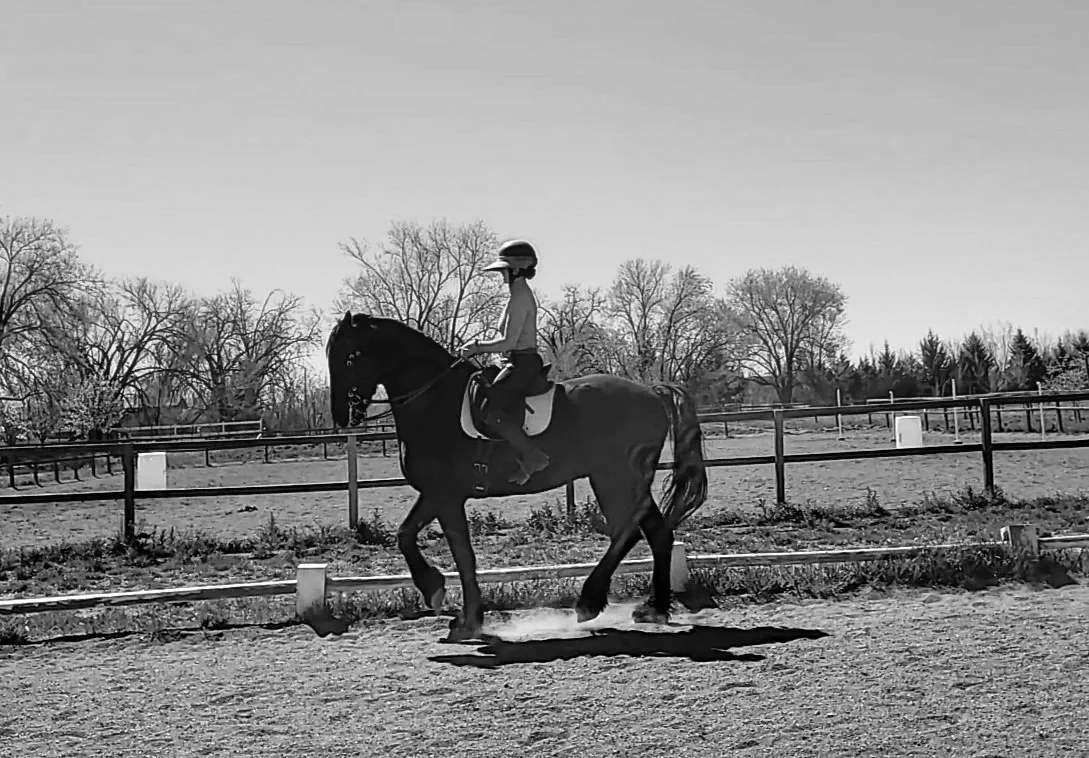
Neck Bend vs Flexion
A horse's neck acts as a balance for its body. The skull is very heavy, averaging 10% of total body weight in a healthy horse. The way a horse carries its neck while in work has a profound effect on its ability to carry a rider in a healthy way. Assuming the goal of forced exercise for a horse is to improve a horse's well being and enhance the ethology already provided by appropriate care, a rider must think critically about the posture a horse's head and neck is guided into. Appropriate neck carriage can be considered (and is) a complex issue made simple by the concept that a correct head and neck carriage will allow the horse to travel straight to the rider's hand from the hind leg, through the shoulder, and allow relaxed neck to telescope from the wither and facilitate a relaxed jaw. What turns this mechanic into a complex and largely inaccessible result for most riders is the amount of confusing and conflicting instruction surrounding biomechanics for horse and rider and the use of the rein. The two most common errors that I encounter are indirect rein usage (regardless of bit) and an obsession with achieving neck bend while neglecting flexion.
Flexion
Flexion refers to the ability of the horse to articulate the poll, atlas and jaw in a soft way and is a key component of the horse being “on the bit.” It is an often neglected step in putting a horse on the aids, and the source of much frustrating resistance for many riders. The horse must be able to move the neck and thoracic independent of the scapulas, and the muscles of the neck should appear to be smoothly engaged and telescoping from the wither all the way to the poll with no bunching or overly flexed cervical vertebra. This, done correctly, has a varied appearance in horses depending on their anatomy and natural range of motion. When looking down at the horse, an opening rein should direct the horse to swing the poll independently side to side with a soft jaw release, WITHOUT affecting the carriage of the neck. Over bending the neck, or “ breaking” the horse at the base of the neck, WILL unbalance the horse from the upright balance that should be the goal of any ridden work. This causes horses to be overly reliant on the inside rein, making it impossible to learn the feeling of “ inside leg to outside rein” that many people discuss but do not achieve. Horses commonly “fall” through the outside shoulder in this posture. The horse may be bent in the neck in the right direction, the nose may even be pulled in, but unless the poll, atlas and jaw align and release correctly, flexion has not been done correctly.
Crossing reins
Physics is not subjective to the fads of internet horse influencers, and so we know to be true that all force travels in a straight line. When the line from the riders hand and elbow is interrupted by auxiliary tack such as a martingale or moved by a leverage bit or nosepiece, the line of force is changed. Think critically about where force is being directed at the horse's anatomy. An extremely common and poor habit is crossing the reins arbitrarily across the horses wither in an attempt to achieve some level of softness, bend, or obedience. But to where and for what? Pulling the rein in causes the mandible to cross as opposed to release correctly downward, straining the TMJ. It rotates the occipital joints in a way that prevents straightness in the neck, breaking the upright balance of the horse. This will cause the horse to feel “ wooden” in the contact, if anyone cared to develop the feel to notice. A quick glance at any diagram of skeletal anatomy will provide a visual into these effects. At best it results in obedience with a heavy feel in the jaw, at worst and over time it will be damaging. This habit it formed and taught do to a lack of understanding of the importance and mechanics of bend vs. flexion. A properly executed opening rein will flex the horses poll, release the jaw, and provide the same level of obedience in the bend without the damaging effects. If necessary, it is better to lift a rein straight up to leverage more bilateral release in a sticky jaw and poll and to then resume training flexion to an opening rein.
Quisque iaculis facilisis lacinia. Mauris euismod pellentesque tellus sit amet mollis.